

Documentation
Condition Builder
The condition builder is the core of WP Brain. Learn how rule groups, AND/OR logic and comparators work.
The condition builder is the heart of WP Brain. It's where you define the rules that decide whether an element is shown.
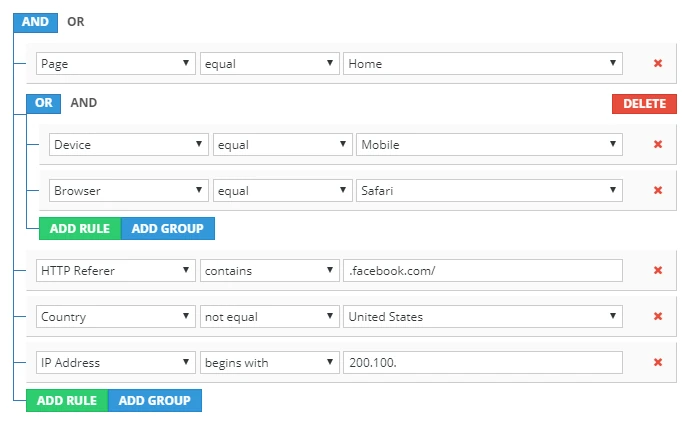
A condition is a group of rules linked by logical operators. It evaluates to true or false: when it passes, the wrapped elements are shown; when it fails, the content inside the next Else container is shown instead.
Logical operators
The rules in a group are connected by one of two operators.
AND — every linked rule and sub-group must be valid. In the main condition, a single failure fails the whole condition. Inside a sub-group, the same rule applies.
OR — only one rule or sub-group needs to be valid. Validation stops as soon as a match is found, and the same applies inside sub-groups.
The builder draws the relationships as a tree of connecting lines, so complex combinations stay readable.
Rule comparators
Every rule needs a comparator that checks the real filter value against the value you provide. The available comparators depend on the value type — numeric values accept more comparisons than booleans, for example.
WP Brain includes 22 comparators, covering almost every comparison you're likely to need:
| Comparator | String / Version | Integer / Double | Date / Time | Boolean |
|---|---|---|---|---|
| Equal | Supported | Supported | Supported | Not supported |
| Not equal | Supported | Supported | Supported | Not supported |
| In | Supported | Supported | Supported | Not supported |
| Not in | Supported | Supported | Supported | Not supported |
| Less than | Not supported | Supported | Supported | Not supported |
| Less than or equal | Not supported | Supported | Supported | Not supported |
| Greater than | Not supported | Supported | Supported | Not supported |
| Greater than or equal | Not supported | Supported | Supported | Not supported |
| Between | Not supported | Supported | Supported | Not supported |
| Begins with | Supported | Not supported | Not supported | Not supported |
| Doesn't begin with | Supported | Not supported | Not supported | Not supported |
| Contains | Supported | Not supported | Not supported | Not supported |
| Doesn't contain | Supported | Not supported | Not supported | Not supported |
| Ends with | Supported | Not supported | Not supported | Not supported |
| Doesn't end with | Supported | Not supported | Not supported | Not supported |
| Is empty | Supported | Not supported | Not supported | Not supported |
| Is not empty | Supported | Not supported | Not supported | Not supported |
| Is null | Supported | Supported | Supported | Not supported |
| Is not null | Supported | Supported | Supported | Not supported |
| Regular expression | Supported | Not supported | Not supported | Not supported |
| Yes | Not supported | Not supported | Not supported | Supported |
| No | Not supported | Not supported | Not supported | Supported |
Some comparators take two values (“between”); others take none (“Is empty”, “Is not empty”, “Is null”, “Is not null”, “Yes”, “No”).
Built-in filters
WP Brain ships with a large set of filters. The possibilities are broad — you only need to find the right combination for your conditions.
- Page: show content only on specific website pages
- Page Template: show content based on page templates
- Post Type: filter content visibility based on post type
- Taxonomy: show content only in some taxonomy archives
- Page Type: target archive, front page or blog pages
- Pagination Number: show content on specific archive pages
- HTTP Referer: target visitors arriving from a specific URL
- Device: show different content on different devices
- Operating system: control content for each operating system
- Browser: control content visibility based on the visitor's browser
- Browser version: control content visibility based on the visitor's browser version
- Logged in: show content only for logged-in members
- User: filter content by specific user IDs
- Role: target members based on their role
- Country: display content based on the visitor's country
- Region: restrict content visibility to specific regions or states
- City: restrict visibility based on the visitor's city
- Continent: restrict content visibility to specific continents
- EU Member: target visitors from the European Union
- Latitude: restrict content by latitude
- Longitude: restrict content by longitude
- IP Address: restrict content visibility using the visitor's IP address
- Date: show content for a specific date range
- Datetime: show content for a specific date and time range
- Time: show content during a specific time period
- Minute: control the visibility of elements by the clock minute
- Hour: control the visibility of elements by the clock hour
- Day: control the visibility of elements by the calendar day
- Day of week: control the visibility of elements by the day of the week
- Month: control the visibility of elements by months
- Year: control the visibility of elements by year